Pages

Wednesday, March 18, 2026

It wasn't me

After receiving a number of inquiries, I just want to make a public statement that I did not recently, not have I ever, hacked anyone's email.  

And for anyone who has had their email hacked, it's your own fault for using the password NellsOnKeezNuts69.


Monday, January 19, 2026

With Apologies to Emo Phillips

"Once I saw this guy on a bridge about to jump. I said, "Don't do it!" He said, "Nobody loves me." I said, "God loves you. Do you believe in God?"

He said, "Yes." I said, "Are you a Christian or a Jew?" He said, "A Christian." I said, "Me, too! Protestant or Catholic?" He said, "neither." I said, "Me, too! Nicene or anti-Nicene?" He said, "Mormon." I said, "Me, too! Utah Mormon or Reorganized Mormon?" He said, "Utah." I said, "Me, too! Utah Mormon Temple Square Brethrenite or Utah Dissenting Mormon?"

He said, " Utah Dissenting Mormon." I said, "Me, too! Utah Dissenting Mormon Fundamentalist Polygamist, or Utah Dissenting Mormon non-Polygamist?" He said, "Utah Dissenting Mormon non-Polygamist." I said, "Me, too!"

"Utah Dissenting Mormon non-Polygamist Consul of the Masturbating Chocolatier, or Utah Dissenting Mormon non-Polygamist Covenanteer?" He said, "Utah Dissenting Mormon non-Polygamist Covenanteer." I said, "Me, too!

"Utah Dissenting Mormon non-Polygamist Covenanteer Naegleite, or Utah Dissenting Mormon non-Polygamist Covenanteer of the Womens' Council?" He said "Utah Dissenting Mormon non-Polygamist Covenanteer Naegleite."

I said, "Die, heretic!" And I pushed him over."


https://www.youtube.com/watch?v=ANNX_XiuA78


Sunday, April 6, 2025

Tithing Conferences

One more question:  There exists some real potential for unrighteousness dominion in the collection and disbursements of the tithes collected by the fellowships. Should there be some sort of provenance to call a tithing conference to oversee tithing?  

Should I ask a certain someone to get a revelation for the ekklesia on this matter?

Saturday, April 5, 2025

Womens' Councils Final Exam

Let me preface this by saying I don’t think I’ve met any of the main participants in any of the councils, and I am certainly not familiar in the least with the daily walk of anyone involved.  I do not have knowledge of the facts of the case before the various councils.  With that in mind I write these hypothetical questions, which probably do not resemble the facts of the case. 


1. Suppose a shape-shifting extraterrestrial imitates my form and proceeds to engage in all manner of debauchery in my name. This debauchery is observed by 2 women in my fellowship and as I kneel to bless the sacrament with my fellowship, these two women intervene and say they are not comfortable with me blessing the sacrament and proceed to explain what they have witnessed. Other priesthood holders with valid certificates are present at the meeting. What should I do? Should I, having a valid priesthood certificate signed by 7 women in my fellowship including my wife, assert my rights and continue to bless the sacrament despite their objections?  Y     N

2. Suppose instead of two women being witnesses, the shape-shifting extraterrestrial’s debauchery in my name is recorded on video for the whole world to see. A women’s council is convened, and it is unanimously decided that my priesthood certificate should be removed.  I know I am innocent of the charges, but I cannot convince others that I am.  What should I do?  Should I continue to argue for my innocence and my right to perform ordinances?  Y     N

3. Now let’s change the previous example such that in the women’s council 9 of the 12 women are very good at receiving revelation and they receive the knowledge that it was an imposter doing these things in my name – the women’s council correctly rules that I am not guilty.  However, 3 of the women do not receive the revelation and, having seen the video, they are visibly uncomfortable in their body language with me performing ordinances, but they aren’t making any verbal objections, wanting to keep peace and respect the outcome of the council. Other priesthood holders with valid certificates are present at the meeting. What should I do?  Should I bless the sacrament? Y     N

4. Does your answer to the previous question change if the 3 women are vocal in their objections? Y     N

5. Same as previous example, but 12 of 12 women in the council receive the revelation that I am innocent. However, 2 good men who have valid priesthood certificates are present in the fellowship meeting have not received the revelation and, having seen the video, they are visibly uncomfortable in their body language with me performing ordinances, but they aren’t making any verbal objections, wanting to keep peace and respect the outcome of the council. What should I do?  Does the answer change if the ones uncomfortable are men? Should I bless the sacrament? Y     N


Moving on from extraterrestrial shapeshifters…

6. Consider an instance in which a women’s council exercises unrighteous dominion: Suppose that 12 women in my fellowship observe me wearing a New York Yankees cap. There is no scriptural commandment restricting this type of belief, but they decide unanimously that since their favorite blogger roots for Boston, my priesthood certificate should be removed.  My wife was out of the country for business during the council and did not participate. I plead my case and appeal to scriptures and note that the blogger has never cast aspersions on the worthiness of Yankee fans, but they are adamant: no worthy priesthood holder can root for the Yankees.  They cannot listen to persuasion.  What should I do? Should I baptize a fellowship member despite their unrighteous objections? Y     N

7. Can I tell my friend “How about, just for today, we form a fellowship consisting of me, you, and our wives, the ladies sign a certificate for me, and I go baptize you?” Y     N

8. Should I call up the blogger to voice my objections and ask him to persuade the 12 women to change their mind, or remove them from the covenant body if they persist in this unrighteousness dominion? Y     N

9. If the blogger blocked my number years ago after I incessantly called him at 3am to ask him to give a celebrity endorsement to my new brand of bedding called "Second Comforters," should I call up the blogger's wife instead to voice my objections and ask her to settle the matter?  Y     N


10. Suppose that a women’s council consisting of 12 covenant-taking women who I have never met from a fellowship I do not belong to call themselves “the ninth circuit women’s council” and, having seen 365 photos from 365 consecutive days of me walking my dog while wearing a Yankees cap, unanimously request that I give surrender my priesthood certificate to them. Should I baptize a fellowship member despite their unrighteous objections? Y     N


In all the above examples, the stakes are low, as “Aaronic priesthood is durable” and the ordinances seem to be valid regardless of the worthiness of the priesthood holder.

11. Now let’s raise the stakes a bit – suppose that as a condition of for the return of Zion, some sort of prayer must be performed to invite Enoch and his friends to return.  And suppose that this prayer requires at least 8 couples to arrange themselves in a prayer circle, and it is well known that for this order of prayer to be effective, all the individuals in the circle must have the best of feelings toward each other.  On this blessed day, my wife and I and 8 couples are invited to perform the ceremony, so it is possible to lose one couple and still complete the invitation.  Many decades ago, I had treated one woman in the circle (not my wife) very cruelly when we were both young children.  I feel awful about what I had done as a young boy, and while I have apologized profusely many times, I can tell that the woman has just never been comfortable around me—she still, after so many years, can be cordial with me but will never look me in the eyes.  Everyone present has been waiting and working for over ten years (and possibly ten million years) for this moment, but one of us has to step out of the circle to send out the invitation.  Should I step out of the circle instead of trying to convince her that she should leave?  After all, she’s the one with the bad feelings. Y     N

12. If your answer to the previous question was N: My efforts to persuade her to leave the circle were not persuasive enough.  I could leave the circle, or try to persuade the other couples to ask her to leave. Should I leave the circle? Y     N 


Saturday, October 26, 2024

A worthwhile modernization


"So hold up...even though it was translated before 1830, it was written in King James English?"

"Joe, you have to understand, these people fly to pieces like glass as soon as anything comes that is contrary to their traditions."

"But later on, they put up with harems?  Brigham Young has a bigger body count than even you do!"

"Joe, this new Book of Mormon, they're calling it the Covenant of Christ.  I'm telling you it's the most amazing thing ever.  Even stupid people like Kamala can understand it. But it hits right back at crooked Brigham.  It says 'I will have covenant people, says the Lord of Hosts, and we all know Lord of Hosts means he's a great general, a real Robert E. Lee type, and they will hearken to this commandment to only have one wife.' "

Monday, April 8, 2024

Sorry, guys

I think this is on me.  Evidently the heavens did not want to see any of our perineums, and took drastic measures to prevent it...


But seriously...Am I the only one who feels unusually disappointed?  And also feeling weird for feeling disappointed?  Is it about feeling like I've missed out on something important, hoping for a break in the clouds at the last minute?  What was I hoping for?  

Maybe someone will come up with an amazing inspiring photo from western New York and find the literal silver lining.

I'm not a woman, but it almost has a miscarriage-like feel to it, a sense of loss where you know there are still other opportunities, and you don't know why it hurts so much.  

I feel like there's some meaning in it, but I also feel dumb for thinking there's some meaning to it.  Both at a macro level for whatever this movement is, but also at a micro personal level, as my home is also in today's zone of totality, and it is pretty close to where the eclipse conference took place. I thought about heading home from the conference early to watch the eclipse to beat the traffic, but didn't.

My house had clear skies and a perfect view of the entire eclipse.  Cue the Curb Your Enthusiasm music.

Why is this such a big deal to me? It doesn't make sense.

For those at today's conference, am I the only one?

Sunday, April 7, 2024

Announcement: Eclipse Perineum Sunning Workshop

 To be led by Perineum Expert Dr. McKay Platt and Astro-Philosopher Bryan Lang:


I'm sure we're all wondering how to best harness the power of the upcoming solar eclipse to energize our spirits and bodies.  In this Monday Morning eclipse conference workshop we will discuss something that was part of the original religion of the Fathers, perineum sunning during a total solar eclipse.

The Book of Yasher-halal-hash-baz noted that Enoch himself was born during a total solar eclipse, as though the fiery portal itself opened up to enter this world in the same way he exited it.


Note: since a certain someone has only about 3 pictures of himself on the internet (mugshot included), chatGPT has not been trained on his face, and we will therefore be denied the opportunity to have an AI-generated photo of him absorbing these sacred rays on his fourth eye.


Thursday, August 26, 2021

Zion and the jab

I was reading the “build a house” parable today.  The group who wanted to haul the stone to the place had the much harder path than those who found the clay on site and made bricks.  

"Those who had compassion said, The master's house is finished. What need is there for further labor to carry stone for the house? Let us not waste the effort of our fellow servants who have labored hardest, and we will put the stones to good use."

The stone builders were in the wrong, but those who had compassion (and the master) found value in the labor of the stoners.


In the end the Master said that 

"all of you have labored to do as I have commanded, and proven your faithfulness."

--even though there was “a season of quarreling and disputing”

"I ask again, What have you learned? What ought you to have learned?

…But I say again, there was honor in the labor of others. Whereas I look upon the heart and see faithful service, many among you do not look at, nor see, nor value what I the Lord love in the hearts of my people. As I have said before, I say again, Love one another, labor willingly alongside each other….All who have been faithful are mine." (emphasis mine)

There are specific and general implications in this parable.  Perhaps one thing that we ought to have learned is that it seems that the master is very generous in accepting the genuine labor of the servants, even if it happens to be wrongheaded.  Perhaps the Lord isn't looking for a people who are right about everything all the time.


So let’s talk politics and covid and all that.  Those who believe that the vax is more bad than good probably have an obligation to warn their neighbor about it.  And those who believe the vax is more good than bad probably have an obligation to warn their neighbor about it. One group is more or less correct. Time will perhaps tell.

"Friendships have been and are being undermined because of conflicting opinions about this virus. A great deal of the basis for the current opinions are based upon rumors, suspicions, fears and outright lies. Both ill-informed social media and respected leaders have used this as a wedge issue to divide us. Why are we letting that happen? It is our choice to respond with fear and anger."

There is honor in both people’s labor, even if they see the world differently from you. If we cease to be able to labor willingly alongside each other, we may be in danger of not being considered faithful.


Monday, September 14, 2020

Baghdad & Babylon

 Five years ago Dave posted on his blog:

"The God of Heaven tells me all the world should pray that Baghdad does not fall." 

It seemed to me at the time that the issue at hand for Baghdad at the time was ISIS, who occupied territory near Baghdad. I said my prayers for Baghdad at the time, and while I can't definitively take credit for the downfall of ISIS, ISIS definitely seems to have been defeated.  Indeed, ISIS peaked in late 2014 and was already beginning to decline by the time Denver made this post in February 2015, with Iraqi forces retaking Tikrit (87 miles NW of Baghdad) on March 12, 2015.


But May 28, 2015 Dave followed up with another post, just after ISIS took control of Ramadi on May 17, 68 miles to the west of Baghdad:

"Days of distress are upon Baghdad and the days of their troubles are begun. Distress shall overtake them, for those who come shall have no pity."

This seems to indicate that Baghdad would fall, and that our prayers did not abate the Lord's ire.  However, ISIS has seemed to be the nation to fall, and Baghdad remains in the hands of the Iraqis. 

But the title of the Denver's February post is Babylon, not Baghdad.  And while Baghdad falls within the borders old Babylonian empire, I'm wondering if Baghdad actually means Babylon, as in 

"The God of Heaven tells me all the world should pray that Babylon does not fall." 

But then why would we pray that Babylon does not fall, when Babylon are the bad guys?  Shouldn't we be praying that Babylon does fall? Perhaps it depends on what replaces Babylon, and what happens between the fall of Babylon and the Lord's return in glory.  Much like what replaced Saddam Hussein in Baghdad wasn't necessarily an improvement over Saddam (even though he was a monster), the chaos that follows the fall of Babylon and its economic and political institutions might be even worse than Babylon if Zion is not ready for the fall of Babylon.  

If we take our parallels from the Book of Mormon, are the Gadianton robbers Babylon, or are they what comes after Babylon?  Or if the Gadiantons are Babylon, then what follows is the low point of 3 Nephi before the coming of the Lord--the fall of the government, the people dividing into tribes, and eventually, destruction.  The  Book of Mormon makes no specific mention of Babylon by name on the Large Plates of Nephi (only on the small plates).  

So if Baghdad means Babylon in Dave's first post, does the followup post fit Babylon rather than Baghdad?
"Days of distress are upon Babylon and the days of their troubles are begun. Distress shall overtake them, for those who come shall have no pity."

In 2019 I would have said no, but this year...well, all of Babylon's institutions seem to be crumbling.  I don't know who will win the 2020 US election, but I will predict with confidence that whoever loses this election will not see the outcome as legitimate.  

Sunday, April 5, 2020

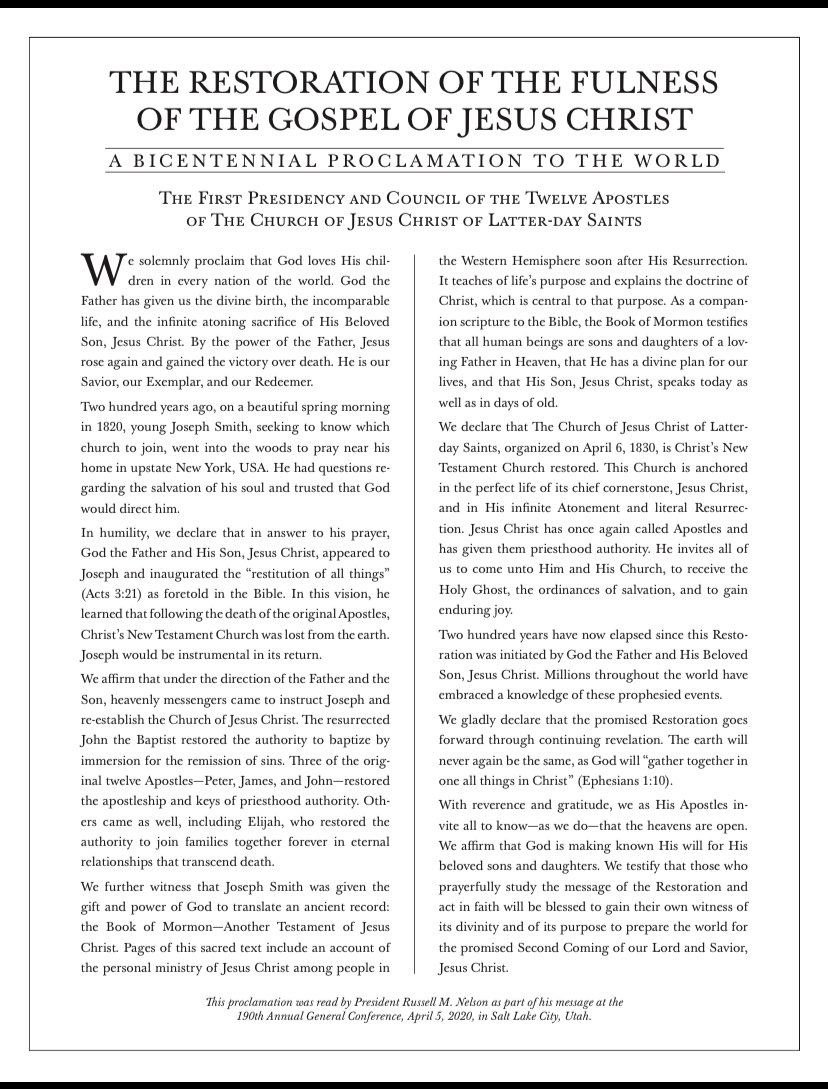
Interesting symbolism in the hosanna shout


We've had 5 proclamations now. Like them or not, the 1st 3 all had new information, and were not received with a hosanna shout.  The Living Christ proclamation received no hosanna shout.

The symbolism of 3 old men alone in a room shouting hosanna has some impressive symbolism. Will the last person to leave the church please turn out the lights?


via GIPHY


Given that the leaves were green in upstate NY, this was taped no later than September 2019.  This is the big thing they’ve been building up to even before the last conference. They're all out of ideas. They give us regurgitated slop and expect us to shout with joy.

There is actually some nice symbolism in Joseph opening the dispensation in a grove of barren trees

But the word hosanna--God save us-- is fitting: We can still look to God and not these jokers.

Joseph Smith said that “no unhallowed hand can stop the work from progressing” While I wouldn't claim that God sent a global pandemic just to own the morms,  It seems like corona has stopped the church's work from progressing.


Me seeing Nelson in the sacred grove:

via GIPHY


Friday, October 4, 2019

What does a society of prophets look like?


hey guys...I'm getting kinda nervous here...


Given that failure is definitely an option for us...

Are we deferring too much to Dave and in so being darkened in our minds?  A comment from Denver holds a lot of weight in deciding relatively inconsequential matters:
Some thoughts shared with me from a conversation Denver had with one of the committee members indicated that the chronological order of that particular talk (OUR DIVINE PARENTS) is not critical.
While I believe Dave has stood before the divine council, part of me wonders if we should not be ascribing special weight to his opinions in places where he is not claiming any revelation.

I don't say this to call out others for their deficiencies, I see this in myself.   We need a society of prophets, where no one says "Know ye the Lord?" but I am not a prophet.  And the reason why we all  defer to Denver is that we don't trust anyone else to be a prophet for us.

I think the solution isn't for me to be able to trust your revelations, or for you to trust my revelations.
Therefore, let every man stand or fall by himself, and not for another, or not trusting another. (RE Mark 5:17, LE JST Mark 9:44)

It is for us to each get our own revelations.  For every man to stand or fall by himself, and to allow his neighbor to stand or fall by himself. To have the law written on our hearts. (Romans 2:15).  For me to trust you to get revelations for you, and for you to trust me to get revelations for me.

A Common starling.  Not much to look at. 
But what would our society look like if we were all our own prophets?  We've never seen such a society, and the scriptures are scant on the issue.

It seems likely that we would be in each others' business a bit less, trusting that each can hear God's advice.  And for those who can't hear God's voice, that would be job one for that person.

But sometimes a covenant body needs to coordinate to accomplish something, like write a statement of principles or build a temple.
Murmuration Starlings GIF
Murmuration of Starlings.  Beautiful. 

How on earth do we coordinate to build a temple?  If the temple is our bodies housing the Spirit of God, then the answer is well-known.  But if it's a physical building that a corporeal Jesus will visit, then there will need to be coordination among a body of believers.  But I suspect the command to build a temple will not come until the covenant body has the law written on each member's heart, where each of us (or enough of us) is led by the Spirit.  If a command to build a temple comes and we do not have the law written on our hearts, then it will end like Nauvoo.  If our hearts aren't right, none of this matters.  If our hearts were right, we could coordinate like starlings, with no one in charge but the Lord.  I think Dave is really tired of being the head guy in this movement.

Matters of governance such as which of Dave's quotes to include in our scriptures are only practice in learning to get along at this point.   Keep in mind that if the movement succeeds, we get Jesus and an unsealed Book of Mormon.  A hundred years from now, our yak leather bound set of remnant scriptures will either be replaced with white stones, or it will be kept in an Lamanite museum next to Brigham's walking cane and the conference center podium made from GBH's tree as a reminder of the hubris of failed dispensations.

None of this matters if we aren't individual prophets.  It just doesn't matter if we include words denoting that a loving Mother was behind the word of wisdom.

It just doesn't matter if we get the scripture project exactly perfect.

It just doesn't matter if we got the best Guide & Standard or not.

It just doesn't matter if Dave is a truer prophet than Russ.

It only matters that we each become the kind of people who can live in peace, because those are the people that the angels can gather to Zion.

Many of us (myself included) have forgotten why we got on this spiritual path in the first place.  It was because we each discovered that the keeper of the gate is the Holy One of Israel, and he employeth no servant there.  That we should follow no man.

But now we are in real danger of being The Church Of Denver, "but receiv[ing] not the gospel, neither the testimony of Jesus, neither the prophets, neither the everlasting covenant.”  Against Denver's wishes, ironically.

If we fail, let's at least fail differently from the LDS from which we came.


Wednesday, September 4, 2019

Musical Extravaganza Oct 6


The Servant David's 66th Birthday Celebration

October 6, 2019
Location:  Chuck-A-Rama in Murray, UT


A gala celebrating the 66th birthday of The Servant David will be held Sunday, Oct 6, 2019, at 8:00 p.m. mountain daylight time at the Chuck-A-Rama in Murray and will be broadcast live in nine languages on youtube.

Performing artists CuvBruvz, one of Gladys Knight's former Pips, the group of people who say "Welcome to the Denver Snuffer Podcast", and Wayne Osmond will join the Mormon Tabernacle Choir (It's just a bunch of Adrian Larsen's family--but why not since the name is no longer taken).

The birthday celebration will share insights into the life, ministry, and service of The Servant Formerly Known as Denver. A puppet show will focus on how his career, family, and ministry have shaped who he is as a special witness of Jesus Christ. 

Log will jump out of a birthday cake and sing "Happy Birthday Mr. Servant Dave."

While the obsequiousity is free, and the fun and feelings will be complimentary, dinner will cost $15.99 for adults, $13.59 for seniors over 60, and children at the rate of $1.15 per year of the child's age.  As always, children 3 and under eat free.


Sunday, August 18, 2019

Abinadi & Sidney

Compare these two firebrand preachers:


Yea, wo be unto this generation! And the Lord said unto me: Stretch forth thy hand and prophesy, saying: Thus saith the Lord, it shall come to pass that this generation, because of their iniquities, shall be brought into bondage, and shall be smitten on the cheek; yea, and shall be driven by men, and shall be slain; and the vultures of the air, and the dogs, yea, and the wild beasts, shall devour their flesh. And it shall come to pass that the life of king Noah shall be valued even as a garment in a hot furnace; for he shall know that I am the Lord. And it shall come to pass that I will smite this my people with sore afflictions, yea, with famine and with pestilence; and I will cause that they shall howl all the day long.

Yea, and I will cause that they shall have burdens lashed upon their backs; and they shall be driven before like a dumb ass. And it shall come to pass that I will send forth hail among them, and it shall smite them; and they shall also be smitten with the east wind; and insects shall pester their land also, and devour their grain. And they shall be smitten with a great pestilence—and all this will I do because of their iniquities and abominations.

And it shall come to pass that except they repent I will utterly destroy them from off the face of the earth; yet they shall leave a record behind them, and I will preserve them for other nations which shall possess the land; yea, even this will I do that I may discover the abominations of this people to other nations. And many things did Abinadi prophesy against this people.
One cause of our heavy persecutions, is the influence which those have in the world, whom we have separated from the fellowship of the church for their wickedness; who attempted to gratify their vengeance on us, and also to hide their own shame, by foul slanders and base calumny. We were at one time represented by them, as having all things common: at another as being enemies to the government: and in other places we were reported to be abolitionists, and indeed any thing, they thought best calculated to stir up the public mind, and to excite popular indignation; and if possible, put an end to the work, by sacrificing some of those who were considered as most active in supporting and defending the cause. But through the mercy of God, we are still in existence, and have the opportunity of joining with you in the privileges of this day.

Our cheeks have been given to the smiters, and our heads to those who have plucked off the hair. We have not only when smitten on one cheek turned the other, but we have done it, again and again, until we are wearied of being smitten, and tired of being trampled upon. We have proved the world with kindness; we have suffered their abuse without cause, with patience, and have endured without resentment, until this day, and still their persecutions and violence does not cease. But from this day and this hour, we will suffer it no more.

We take God and all the holy angels to witness this day, that we warn all men in the name of Jesus Christ, to come on us no more forever, for from this hour, we will bear it no more, our rights shall no more be trampled on with impunity. The man or the set of men, who attempts it, does it at the expense of their lives. And that mob that comes on us to disturb us; it shall be between us and them a war of extermination, for we will follow them, till the last drop of their blood is spilled, or else they will have to exterminate us: for we will carry the seal of war to their own houses, and their own families, and one party or the other shall be utterly destroyed.


On the left, we have Abinadi, and on the right we have Sidney Rigdon.  Both were preaching hellfire & damnation to a wicked generation.  Abinadi did so by God's request.  Sidney did so on his own errand.

Abinadi's words, while they got Abinadi burned, lit a fire in the heart of Alma and created a movement that swept the Nephite nation.  Sidney's words enflamed the hearts of the Missourians with anger to burn the homes of many saints.

While the duty is upon us to warn our neighbor, it is not our duty to poke the beast. Warn your neighbor one on one as the Spirit suggests.  If God asks us to publicly recite the abominations of LDSCorp, then, of course we should do so.  But your friends and family are less likely to listen to you after you get excommunicated. Provoking a billion dollar church with its own semi-secret police will likely turn out badly, nor will it bring Zion.  My uneducated opinion is that Zion gets established quietly, gathered by angels.  The LDSCorp should worry about John Dehlin more than it should worry about the remnant.

Be charitable and patient and labor to reach others. They will judge you harshly, but nevertheless be kind to them. They are going to grow to fear you, but that’s only part of how darkness responds to light. Give them no reason to fear you. The time will come for us to gather, but between now and then, be leaven. Preserve the world. Be salt. Preserve the world, even if it hates you.


Never go Full Abinadi (unless God asks you to).

Don't gladly anticipate the destruction of the wicked.  Make intercession for them.  Love your enemies, or you might share their fate.

Friday, March 22, 2019

Life is Unfair, But You Knew That

Note:  Tim Malone was kind enough to post this on his blog for me some years ago here:

https://latterdaycommentary.com/2015/08/21/life-is-unfair-but-you-knew-that/

I just wanted to repost it here in my blog.

***

Why is there suffering? And why is life so unfair? Why do some have bigger burdens than others? Why do so many people live in poor wartorn countries?

One possibility is that the abused deserve their abuse—that perhaps they were an abuser in a previous life.  This kind of thinking, even if true, can enable abusers—“You totally deserve my abuse, who am I not to fulfill God’s will?"  This is the dark side of Hindusim--"we have a caste system because God wills it--we brahmins are on top because of our exceeding righteousness in the past life and you losers are living in squalor because you weren't as righteous in the last life.”  Even modern prophets seers and/or revelators can fall victim to this kind of thinking:


"This privilege of obtaining a mortal body on this earth is seemingly so priceless that those in the spirit world, even though unfaithful or not valient, were undoubtedly permitted to take mortal bodies although under penalty of racial or physical or nationalistic limitations…."  Harold B. Lee

On the other hand, was Jesus abused because He was an abuser?  What about Abinadi, Paul, Peter, and Joseph?

There is another possible explanation why people endure horrible things in life:  Before the earth is created, God says, "I have to respect free will, and some jerk is going to be an abuser.  Who will volunteer to take this douche's abuse?  Who will volunteer to starve in Africa? Under the volunteerism explanation, it really flips around the question of who the elect really is, and all of us might be found wanting.  


[Never mind, we're totally the elect, not those other guys who are suffering.]

Either explanation is possible, maybe some are abused as punishment and others volunteered for abuse.   We can't judge.

I suggest a third possibility: some of the abused neither deserved it nor volunteered for it.  Life isn't fair, and that might be part of the test--can we love and accept a God who set up a rigged game?

Look at the 9th parable in Dave's 10 parables. My interpretation of it is, basically, that those who followed Lucifer in the premortal life are invited back into the kingdom. Many who were righteous were upset by this and walked out on God. The test is not what we think it is.


From the 9th_Parable:
After the days of the competition ended, a great feast was called. For the feast, the King invited not only those citizens who participated in the games, but also those who had fled the city rather than participate. Those who had remained loyal and participated in the games were troubled by this.
“Why are those who rejected your plan allowed to be among us?” they inquired. 
“For a wise purpose,” said the King. 
Many of those who participated resented the presence of those who had fled. Some who fled returned in anger, urging those who stayed to join them in their anger at the King. Some who did not do well were persuaded by the arguments of the returning dissidents.
The great feast turned into a great argument among the residents who stayed and those who had fled. Eventually the people divided themselves into two groups. In one, the King was beloved and his plan was held in esteem. In the other, the King was resented, or worse, hated. They found fault with the King, with his plan, and with the uproar caused among the citizens by the King’s great folly. 
When the body was divided, the King addressed them all with these words, “I have been working for some time to determine who I can trust among our people and who I cannot trust. Using wise counsel I have adopted this great plan to decide the matter. 
“I knew when the competition was devised it would divide the people. I knew, too, that some would flee rather than participate. I also knew if I invited back to a feast all of the citizens, both those who stayed and those who fled, that it would result in a great division. This was my purpose all along. 
“We are faced with many challenges. Some are in forms which you do not understand. 
They will test all of us. I must know before we confront the coming challenges who I can trust to remain loyal in my kingdom. Today I know.


The game is rigged. On purpose. And not because God is incompetent. Or evil. God wants to see who will not be upset if He rewards people unfairly.  Consider Jesus' parable of the laborers:


Matthew 20:1 For the kingdom of heaven is like unto a man that is an householder, which went out early in the morning to hire labourers into his vineyard.
2 And when he had agreed with the labourers for a penny a day, he sent them into his vineyard.
3 And he went out about the third hour, and saw others standing idle in the marketplace,
4 And said unto them; Go ye also into the vineyard, and whatsoever is right I will give you. And they went their way.
5 Again he went out about the sixth and ninth hour, and did likewise.
6 And about the eleventh hour he went out, and found others standing idle, and saith unto them, Why stand ye here all the day idle?
7 They say unto him, Because no man hath hired us. He saith unto them, Go ye also into the vineyard; and whatsoever is right, that shall ye receive.
8 So when even was come, the lord of the vineyard saith unto his steward, Call the labourers, and give them their hire, beginning from the last unto the first.
9 And when they came that were hired about the eleventh hour, they received every man a penny.
10 But when the first came, they supposed that they should have received more; and they likewise received every man a penny.
11 And when they had received it, they murmured against the goodman of the house,
12 Saying, These last have wrought but one hour, and thou hast made them equal unto us, which have borne the burden and heat of the day.
13 But he answered one of them, and said, Friend, I do thee no wrong: didst not thou agree with me for a penny?
14 Take that thine is, and go thy way: I will give unto this last, even as unto thee.
15 Is it not lawful for me to do what I will with mine own? Is thine eye evil, because I am good?
16 So the last shall be first, and the first last: for many be called, but few chosen.


But why? Why is the test about enduring unfairness rather than testing who will obey the commandments the most?

When we perceive that we are treated unfairly, we seek compensation to make up for our unfair treatment. We think it will be just if something is taken from the person who has more and given to the person who has less. Well, maybe we only think it is unjust if we are the person who has less. (When we have more, we pat ourselves on the back and assume that we totally earned it.) This motivation is at the heart of those who seek revenge for mistreatments, either real or perceived.

In the eternities, God offers us everything. He wants to share His glory and power with us. But what if that isn't fair? Why should someone who didn't do the same awesome righteous works as I did get the same reward? Why should a laborer who showed up at the 11th hour get the same pay as I did for working all day?

And more importantly, what can I do to stop this slacker from getting a reward he doesn't deserve? Well, God did give me His power, right? So I can use that to make his eternal reward less than mine. Although it might be hard, since he also has God's power, so if I break any of his stuff he can fix it. But I could probably find ways to make his eternal reward less rewarding. One way (maybe the only way) I could do him harm would be to tempt his children into doing wickedness.

At this point I have become a devil.

This might be why only the best of feelings (charity) can prevail between people if they will enter into a true order of prayer—prayer doesn’t become a true order just because the person praying repeats signs and tokens while wearing symbolic clothing. A true order of prayer means that a person has received the power to ask any blessing they want from God. People will only get this power if they have the best of feelings toward their neighbor (charity). People without the best of feelings might ask God to curse their neighbor as compensation for unfairness.

So life is unfair because God cannot save people who are upset by unfairness, or those who will not forgive their neighbor. 


Here’s the 9th parable in it’s entirety:

There was a King who loved his people. He also loved the competition of games. He called his advisory council together and asked them how he might improve the health and vigor of his people. They considered the matter and decided upon a great plan.

The King called his city together and told them of a great competition he and his council had devised. “All the city would compete,” he announced. They would proceed in turns to go into the coliseum and compete on the field. All were welcome to watch before or after they participated, but all would have to compete. The competition would test the citizen’s loyalty, while also improving the lives of the citizens.

“I haven’t the strength to compete. I am old and past my day and cannot hope to win in competition with younger men,” said one.

The King responded, “Not all the competition will be of strength, some will be of intellect, some of patience, some of music. It will develop the skill of each individual from my kingdom and will improve every citizen.”

“I refuse,” said the one. He and those who agreed with him departed in anger.

The day arrived and the competition began. Men, women and children all entered in turns into the coliseum. Some sang, some threw spears, some lifted heavy weights, and some recited poetic works of beauty and wisdom. The people not competing at any given time would watch from the seats. They gained as much from watching as they did competing.

Many were reluctant or afraid entering the competition, but found when they competed their fears were unfounded. Some believed it would be fun to compete. However, upon entering the competition failed to do as they hoped, and regretted their poor efforts.

After the days of the competition ended, a great feast was called. For the feast, the King invited not only those citizens who participated in the games, but also those who had fled the city rather than participate. Those who had remained loyal and participated in the games were troubled by this.

“Why are those who rejected your plan allowed to be among us?” they inquired.

“For a wise purpose,” said the King.

Many of those who participated resented the presence of those who had fled. Some who fled returned in anger, urging those who stayed to join them in their anger at the King. Some who did not do well were persuaded by the arguments of the returning dissidents.

The great feast turned into a great argument among the residents who stayed and those who had fled. Eventually the people divided themselves into two groups. In one, the King was beloved and his plan was held in esteem. In the other, the King was resented, or worse, hated. They found fault with the King, with his plan, and with the uproar caused among the citizens by the King’s great folly.

When the body was divided, the King addressed them all with these words, “I have been working for some time to determine who I can trust among our people and who I cannot trust. Using wise counsel I have adopted this great plan to decide the matter.

“I knew when the competition was devised it would divide the people. I knew, too, that some would flee rather than participate. I also knew if I invited back to a feast all of the citizens, both those who stayed and those who fled, that it would result in a great division. This was my purpose all along.

“We are faced with many challenges. Some are in forms which you do not understand. They will test all of us. I must know before we confront the coming challenges who I can trust to remain loyal in my kingdom. Today I know.

“All those who have been loyal have been identified. They will remain in my kingdom. All those who have rejected my plan, or spoken against me in hatred, will be removed from my kingdom. Those who leave are free to follow their own course. However, they cannot be among my people any longer, for they have been tested and failed in their loyalty.”

It required a battle to remove those who were to be exiled. Many argued they had endured all the King had asked and only spoken ill of him when the disaffected exiles returned. They claimed it was unfair to have been put through this final test of loyalty after allowing the return of the exiles. They argued a feast that included those who refused the King’s request was unfair. It rewarded all alike; the loyal and the disloyal. They claimed their final disloyalty came only as a result of their original loyalty later proving to be of no value, since even the exiles came to the final feast.

Others complained that the King was mad. His whole course was destructive of a people who had once lived in harmony and peace. They claimed it was the King who should be thrown in exile; not the citizens who were discomforted by the King disturbing their peace.

Still others complained the King was never honest with them. Had they known this was to be the result, they would have been loyal throughout. They thought it unfair he kept his counsel to himself and thereby lulled them into disfavor.

Yet others complained the King gave them too hard a test. It was unfair. Although they had passed the test, they had family members and friends who failed and if these whom they loved had failed they would refuse for their loved ones’ sake to remain with the King.

Some even said that the original test was supposed to improve the citizen’s “health and vigor” and not their loyalty. It was unfair to claim to test for one virtue when actually testing for another.

And finally, some claimed there could be no future test coming for which this test of the citizens would prepare; that the only thing this great plan tested was the patience of the citizens. If there is some great future test coming, then the King ought, in fairness, to share that information with them rather than to hide it and make claims which cannot be proven.

All the arguments were unavailing. The King expelled them all. When the kingdom was set, and none but the loyal remained, the King again called a great assembly of his people. To all those who remained the King announced, “I discovered long ago the power to make my kingdom last forever. I am now prepared to share the secrets of all I know with my people. From this day forward you will no longer be citizens in my kingdom, but you will be kings and queens, sharing with me in life which will never end.

“Before making you all kings and queens with me, I needed to have a people who would live in peace together.
Immortality without peace among us would be a great punishment and not a great prize.

“All of us who remain in this kingdom have lost friends, family members and others whom we love. However, all who remain will be able to live in peace, forever.”

The King did as he planned from the beginning. He and his counselors were able to find those who could live in peace, and for whom life would endure in peace forever.

There is not now, and never has been, a kingdom more stable, more happy, more at peace, and more enduring than this King’s. Though he ceased to reign as a king, he continued to be loved above all others. For he was the one who brought to life the happiest people of all.

Thursday, January 3, 2019

Ezekiel & Kurt

To them you are like a singer of love songs, one who has a beautiful voice and plays well on an instrument; they hear what you say, but they will not do it. 

And he likes to sing along
And he likes to shoot his gun
But he knows not what it means

Thursday, December 13, 2018

Nephi and the law

Hat tip to my wife and Max Skousen on this.  So the deal with 1 Nephi 3:7

I will go and do the things which the Lord hath commanded, for I know that the Lord giveth no commandments unto the children of men, save he shall prepare a way for them that they may accomplish the thing which he commandeth them.


is that it shouldn’t be read in isolation. 1 Nephi 3:7 is young man Nephi.  “Give me a commandment and I will totally nail that commandment.”  But then life continues to happen to Nephi:

2 Nephi 4:17
my heart exclaimeth: O wretched man that I am! Yea, my heart sorroweth because of my flesh; my soul grieveth because of mine iniquities. 18 I am encompassed about, because of the temptations and the sins which do so easily beset me. 19 And when I desire to rejoice, my heart groaneth because of my sins; nevertheless, I know in whom I have trusted.


Finally, old man Nephi is channeling Paul:

2 Nephi 25
25 For, for this end was the law given; wherefore the law hath become dead unto us, and we are made alive in Christ because of our faith; yet we keep the law because of the commandments. 26 And we talk of Christ, we rejoice in Christ, we preach of Christ, we prophesy of Christ, and we write according to our prophecies, that our children may know to what source they may look for a remission of their sins. 27 Wherefore, we speak concerning the law that our children may know the deadness of the law; and they, by knowing the deadness of the law, may look forward unto that life which is in Christ, and know for what end the law was given. And after the law is fulfilled in Christ, that they need not harden their hearts against him when the law ought to be done away.


The law is dead and Nephi is alive in Christ.  Nephi's character arc takes him from a righteous young man who thinks he can live the law perfectly into a righteous old man who is transformed by grace.

Sunday, November 11, 2018

Announcement: Infinite Remnant Broadcast

We, as a covenant people, applaud the efforts in engraving the eternal teachings of Denver, even, Dave, on metal plates to be found by future generations after the coronal mass ejection wipes out our modern technologies.

In addition to this effort, scientists from the LZ Slackers Fellowship, with help from John Pratt, are announcing a new initiative.  In an effort to seek the lost sheep remnant, wherever they may be found, we will be broadcasting the complete The Servant Denver Snuffer discography toward Antares.


Furthermore, we will be initiating a broadcast of this message underground for subterranean Israelites.  They will be invited to bring their prophets and their rich treasures, which, we can only assume, consist of a big pile of diamonds to buy us a temple.


Tuesday, September 11, 2018

Touch the Truck for Enlightenment


Young Buddha sought enlightenment, and a car.  Dharma told him he had a great journey ahead of him, for which he would need both.  A local radio station was holding a touch the truck contest, in which the last person to remove his hands from the car, wins the car.

Determined, Young Buddha decided he would sit at the car and meditate until he reached enlightenment.  He was not alone in his quest.  Many Buddhas had also made the journey to seek enlightenment, and the car.

A month passed.  Some of the Buddhas had bowed out of the contest.  They didn't get the car.  It wasn't clear if they received enlightenment.  The radio station didn't expect this to take so long, so they made an addition to the rules:

If all of the people touching the car agree to end the contest together, they can share the car.

The Buddhas thought they could reach agreement; they were all of like mind, they were all devoted to finding enlightenment, and none of them needed the car more often than a couple of times a month anyway.

Agreement was not so easily reached, however.  There were a few factions who had strong opinions about how the car should be used, and all of them had compelling arguments.  Each Buddha wanted to use the car to serve and bless others.

Votes were held.  The Buddhas could not come to unanimous agreement, much to their disappointment.  The great journey awaited each of them, but without the car, they could not embark.  The Buddhas grew frustrated.  It was even proposed that those who disagreed should have their hands pulled off the car, so that the Buddhas could end the waiting ordeal and finally get to their great journey.

Young Buddha said, "Let my skin and sinews and bones dry up, together with all the flesh and blood of my body! I welcome it! But I will not move from this spot until I have attained the supreme and final wisdom. And the car."

The impasse remained.  A year went by. The arguing had died down, but no new solutions were offered.  A few Buddhas took their hands off the car and left.  The long wait gave Young Buddha the time to think, and meditate, and pray.  As more time passed, more Buddhas took their hands off the car, and walked away.  Some angrily, some peacefully. Young Buddha's resolve remained firm.  After all, without the patience to wait for the car, how could he have the patience to withstand the great journey ahead?

A few more Buddhas left until there was only one other Buddha left beside Young Buddha.  They had never agreed on how to share the car, but over the years they had become great friends.  Neither diminished in their resolve, each truly believing that the great journey could not be accomplished with the other's plan for the car.  Still, while their resolve was never diminished, their desire to convince the other was, their thoughts turning inward to meditation.  Finally, Young Buddha, decided that his love for his Buddha brother was so great that he could trust him to decide what to do with the car.  Young Buddha arose, took his hands off the car and walked away.  The car had served its purpose moving him forward on his great journey.

The Buddha that remained, did get the car, in the end.  And, in the end, the car did bless, and serve, and unite the Buddhas.